Published
- 14 min read
Metal Detecting for Gold: A Beginner's Complete Guide
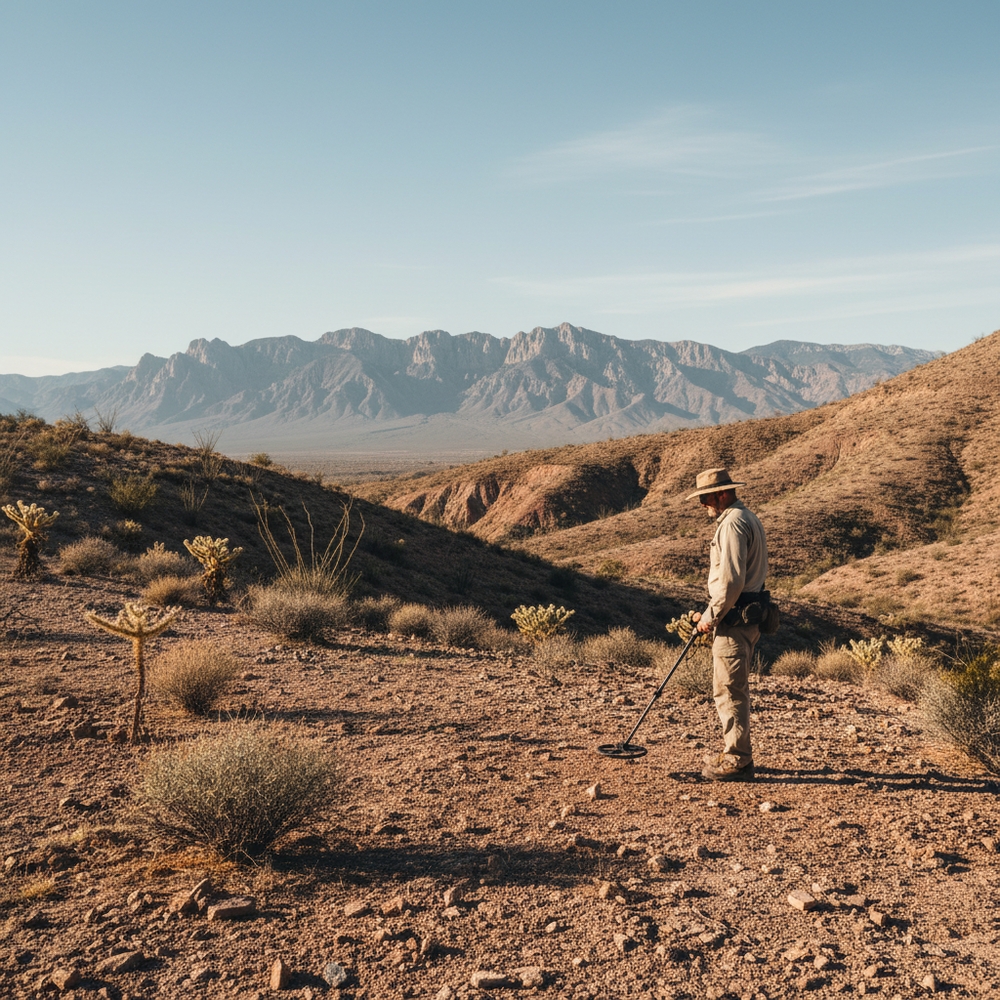
Metal detecting for gold finds what panning never will. Nuggets buried in dry hillsides, specimens sitting in old tailings piles, pieces wedged into bedrock cracks miles from any water source. I spent two years panning before I picked up a detector, and the first afternoon out I found a 1.2-gram nugget in bone-dry ground above a wash in Arizona where a pan would have been completely useless.
That’s the thing most people don’t realize: gold panning and metal detecting aren’t competing techniques. They’re complementary. Panning excels in active waterways where fine placer gold concentrates. Detecting excels everywhere else — dry placers, mine dumps, worked-out benches, desert washes that only carry water during monsoon season. If you’re only panning, you’re ignoring most of the gold-bearing ground in the western United States.
But metal detecting for gold is genuinely harder than detecting for coins in a park. Gold sits in the trash range on every detector. The ground in gold country is mineralized enough to drive you crazy. And gold nuggets are small — most of what you’ll find weighs under a gram. This guide covers everything I wish someone had told me before I bought my first gold detector and spent a frustrating month digging hot rocks.
Why Gold Is the Hardest Metal to Detect
Gold registers in the mid-tone range on most detectors — numbers around 65-75 on a VLF display. That’s the same range as aluminum foil, pull tabs, and small pieces of lead. There is no discrimination setting on any detector at any price that reliably separates gold from trash. None. If someone tells you their detector “locks onto gold,” they’re either confused or selling something.
This means finding gold with a metal detector requires digging everything in that mid-tone range. Every foil wrapper. Every boot tack. Every piece of birdshot. One experienced prospector I watched on YouTube (Ask Jeff Williams — his field videos are genuinely useful) estimates you’ll dig about a pound of trash before your first nugget. That matched my experience almost exactly.
The other challenge is ground mineralization. Gold-bearing ground is loaded with iron minerals — magnetite, hematite, and other ferrous material that makes detectors chatter, false-signal, and generally behave as if every square inch contains a target. This is particularly brutal at old mine sites where a century of disturbed ore has mixed iron-rich material throughout the soil. Ground balancing — the detector’s ability to tune out mineral interference — is what separates gold detectors from park machines, and it’s the single most important spec on any gold detector you consider buying.
VLF vs Pulse Induction: Which Gold Detector Technology to Choose
This is the first decision you’ll make, and it matters more than brand or price.
VLF (Very Low Frequency) Detectors
VLF detectors transmit a continuous electromagnetic signal and measure the frequency shift when that signal hits metal. They’re the technology behind most general-purpose detectors, but gold-specific VLFs run at much higher frequencies — 45 kHz to 71 kHz — because higher frequency means better sensitivity to small, low-conductivity targets like tiny gold nuggets.
Strengths: Better sensitivity to sub-gram gold. Cheaper entry point ($500-$1,200 for a serious gold VLF). Target ID numbers help you evaluate signals before digging. Lighter weight for all-day detecting.
Weaknesses: Maximum reliable depth of 6-8 inches in mineralized ground. Highly susceptible to hot rocks — mineralized stones that trigger false signals constantly. Automatic ground balancing helps but doesn’t eliminate the problem. In severely mineralized ground (which describes most productive gold country), a VLF can become essentially unusable.
Best VLF gold detectors by budget:
- Under $500: Minelab X-Terra series — not a dedicated gold machine, but the higher frequency models will find shallow nuggets in mild ground. Not my first recommendation, but workable if budget is hard-capped.
- $500-$900: Minelab Gold Monster 1000 — this is what I started with and still use regularly. Runs at 45 kHz, automatic ground balance and sensitivity, dead-simple interface. It won’t find deep nuggets but it is ruthlessly effective on small gold in the top 6 inches. I’ve pulled dozens of sub-gram pieces with it.
- $700-$1,200: Fisher Gold Bug 2 — runs at 71 kHz, which is the highest frequency in any handheld gold detector. Absurdly sensitive to tiny gold. The trade-off is it requires manual ground balancing and it’s twitchy in hot ground. Best for experienced operators in moderate mineralization.
Pulse Induction (PI) Detectors
PI detectors send rapid pulses of current through the coil and measure the decay time of the returning signal. This technology essentially ignores ground mineralization — a massive advantage in gold country.
Strengths: Dramatically deeper detection (12-18+ inches depending on target size). Nearly immune to ground mineralization and hot rocks. Finds nuggets that VLFs simply cannot reach.
Weaknesses: No discrimination — you get a beep, you dig. Every piece of iron, every nail, every fragment of fencing wire. Expensive ($3,500-$10,000+). Heavier. Less sensitive to very small gold than high-frequency VLFs.
Top PI gold detectors:
- $3,500-$5,500: Minelab GPX 6000 — widely considered one of the best gold detectors ever made. It’s what serious nugget hunters use in Australia and the western US. Lighter than previous GPX models, excellent depth, and a semi-smart interface that reduces the learning curve.
- $5,000+: Minelab GPZ 7000 — deeper still, uses Zero Voltage Transmission technology. For the person who has detected extensively and wants maximum depth on larger nuggets.
My Recommendation for Beginners
Start with a VLF. Specifically, the Minelab Gold Monster 1000 if you can afford it. The automatic ground balancing and sensitivity adjustments mean you can focus on learning where to detect and how to read signals rather than fighting your machine. I used mine for a full year before I even considered a PI detector, and in that year I found enough gold to know that the hobby was worth investing more into.
If you eventually get serious, you’ll probably end up with both — a VLF for shallow, fine-gold areas and a PI for deeper ground and mine-site work. That’s where most experienced prospectors land.
Essential Gear Beyond the Detector
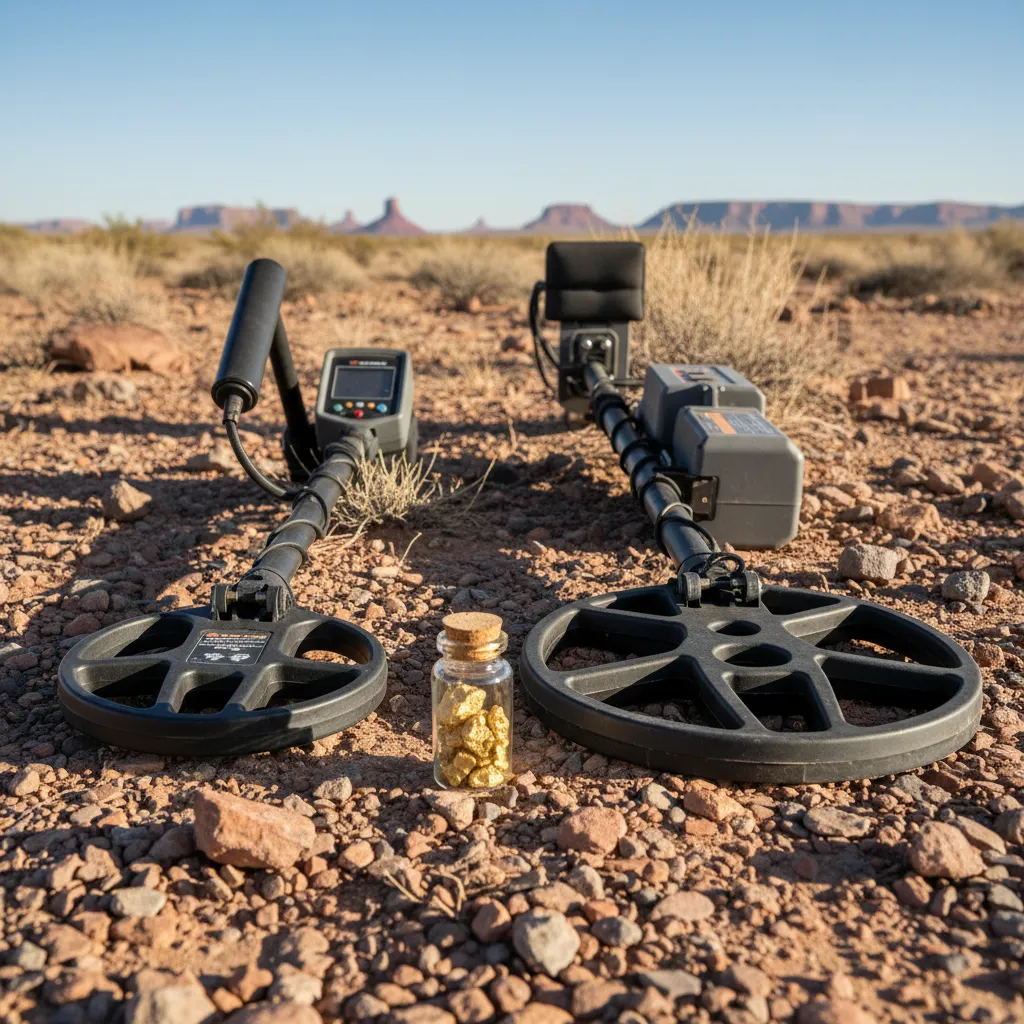
The detector is half the equation. The other half is recovery and identification gear, and skipping any of it will cost you gold.
- Neodymium N52 magnet — attach one to your digging tool. Most trash targets (boot tacks, wire, nails) are ferrous. Touch your magnet to the target when you dig it up. Sticks? Trash. Doesn’t stick? Could be gold, aluminum, lead, or copper. This one habit saves enormous time.
- Pin pointer — a small handheld probe that narrows down the target location in your hole. Without one, you’re digging craters trying to isolate a target the size of a pea. I use a Garrett Pro-Pointer AT. The Whites TRX is also solid.
- Scoop with riffles — for catching small gold pieces that fall out of the dirt when you dig. The riffles trap heavy gold the same way a sluice box does.
- Snuffer bottle — for picking up pieces too small for tweezers. Same one you’d use for gold panning.
- Coil protector — a plastic cover for your search coil. You’ll be dragging it across rocks constantly. Budget for a new one every month or two of regular use.
- Snake boots — if you’re detecting in the desert Southwest, this is non-negotiable. I’ve seen rattlesnakes at three different detecting spots in Arizona. They like the same rocky, undisturbed ground you’re hunting.
Where to Find Gold with a Metal Detector
Location is everything. The best detector in the world won’t find gold where there isn’t any. Here’s where I focus my time.
Desert Placers and Dry Washes
This is where metal detecting has the biggest advantage over every other gold mining technique. Desert placer deposits — gold that was transported and deposited by ancient waterways that no longer flow — can only be worked efficiently with a detector or a drywasher. No water means no panning, no sluicing, no dredging.
Look for old gravel channels on hillsides, dry washes that cut through known gold-bearing geology, and desert pavement (flat areas covered in dark, varnished stones — heavy gold concentrates under these surfaces). Arizona, Nevada, and the eastern California desert are loaded with desert placer ground.
Old Mine Dumps and Tailings
I wrote an entire article on detecting at mine sites because it’s my favorite type of detecting. The short version: historical mining operations had terrible recovery rates. Their waste piles still contain gold — specimens that weren’t rich enough to process, pieces that fell off ore carts, material that the stamp mill didn’t crush fine enough. Detecting tailings is essentially re-mining what old-timers left behind.
Use the GoldFever.app mine map to find abandoned mines near you on public land — it plots over 75,000 USGS-documented mine locations across the US.
Creek Beds and Exposed Bedrock
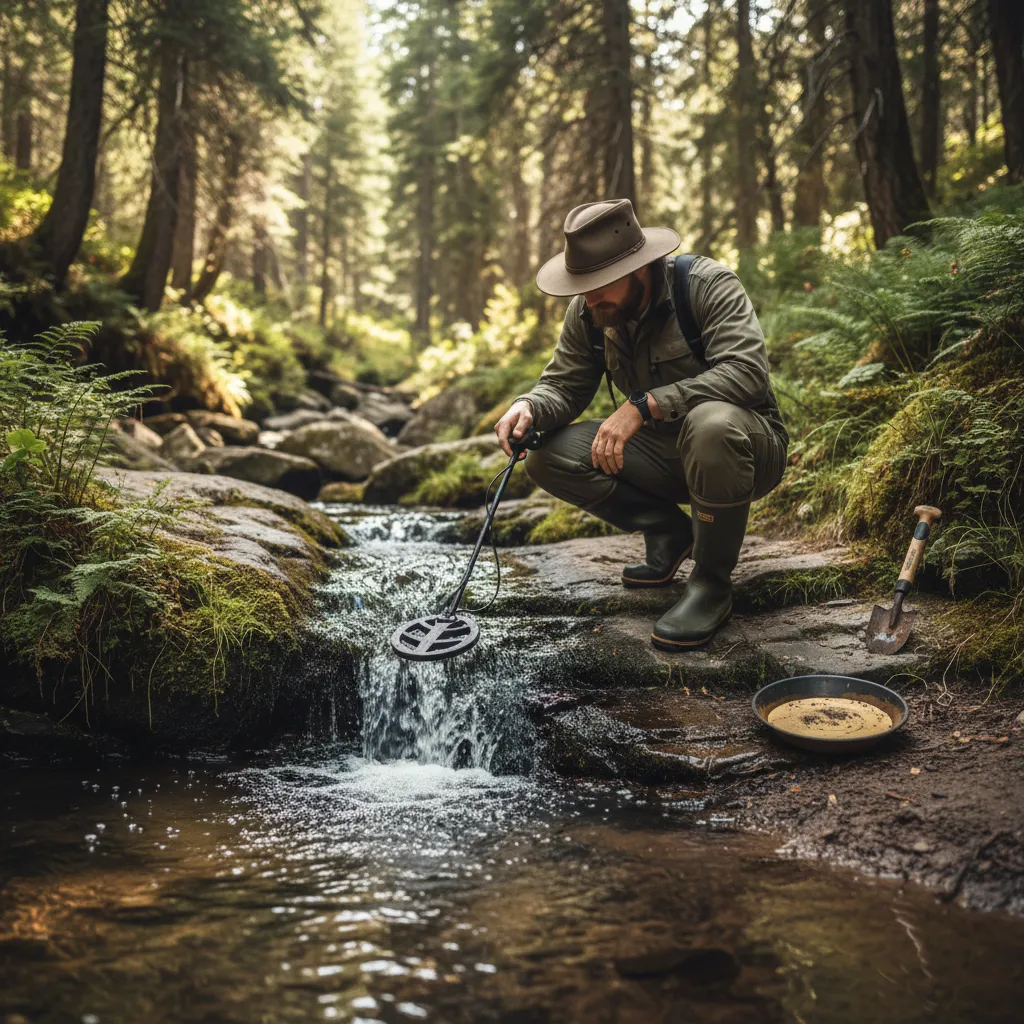
Metal detectors work in water. Swing your coil over exposed bedrock in active streams — gold gets trapped in cracks and crevices that you’d otherwise need to chisel out by hand. Small waterfalls are particularly productive because they create velocity drops where heavy material settles. Large waterfalls flush everything downstream, but drops of one to three feet are gold traps.
The approach I learned from watching experienced Australian prospectors (Vo-Gus Prospecting’s creek detecting video demonstrates this well): use your detector as a prospecting tool first. Scan the creek bed for concentrations of heavy metal — iron, lead shot, old nails. Where heavy metal accumulates, gold accumulates too, because density drives deposition. Once you find a heavy-metal hotspot, switch to your pan and work that specific area. The detector tells you where the gold should be; the pan confirms it.
Field Technique: How to Actually Swing
Technique matters more than equipment. I’ve watched beginners with $5,000 PI detectors walk right over targets that an experienced operator with a $700 VLF would have nailed. Here’s what separates finding gold from finding nothing.
Coil Control
Keep your coil one to two inches above the ground surface. Not six inches. Not resting on the ground. Raising the coil even a few inches costs you depth — and with gold nuggets, every fraction of an inch matters because most targets are small and shallow.
Maintain a slow, overlapping sweep. Think walking pace or slower. Fast sweeps cause the detector to miss small targets because the coil doesn’t dwell over them long enough to generate a clean signal. Overlap each sweep by at least 50% — if your coil is 10 inches wide, advance forward no more than 5 inches between sweeps.
Ground Balancing
If your detector has manual ground balance (most serious gold detectors do), re-balance every time the ground changes visibly — different soil color, more rocks, transition from flat to slope. Mineralization varies dramatically over short distances in gold country. A ground balance setting that’s perfect on red clay will generate constant false signals on black sand ten feet away.
The Gold Monster handles this automatically, which is why I recommend it for beginners. But if you’re running a Gold Bug 2 or any PI machine with manual balance, this habit is critical.
Reading Gold Signals
Gold produces a clean, repeatable signal that doesn’t change significantly when you swing from different angles. This is the single best field test. Swing north-south — get a signal. Swing east-west over the same spot — still there, same tone. Kick some dirt over it — still there but slightly muted. That’s a real target.
Hot rocks produce signals that change character with swing direction or disappear when the coil approaches from certain angles. Iron gives a distinctive grunt or broken tone on most gold detectors — though old, heavily oxidized iron can fool you. Some rusted iron creates a “halo effect” where the oxidation ring around the object triggers a clean signal even though the metal itself reads as iron. I’ve dug ghost targets left by boot tacks that rusted away decades ago — the halo remained in the soil.
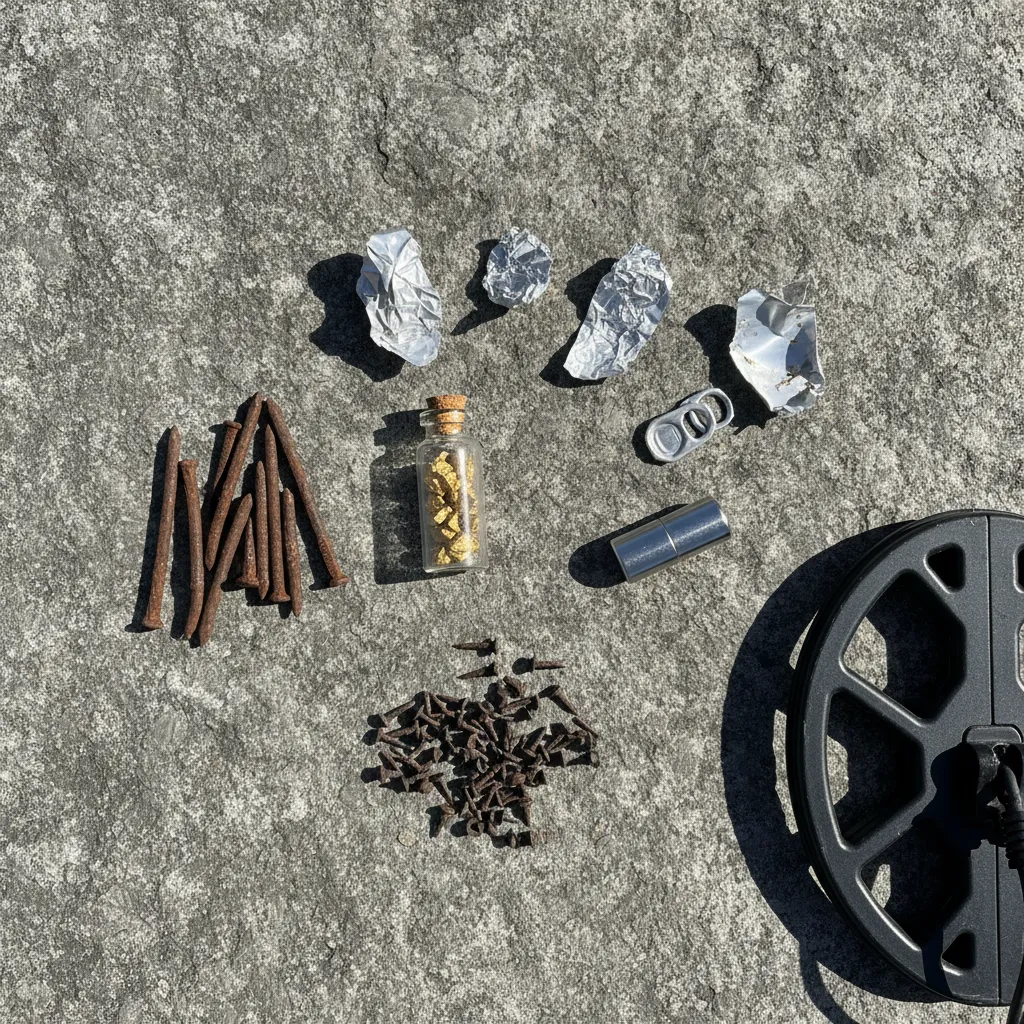
Tinfoil is your nemesis. It reads identically to small gold nuggets on every detector. There’s no way to distinguish them without digging. A neodymium magnet won’t help either — tinfoil isn’t ferrous. You just have to dig it, confirm it’s foil, curse quietly, fill your hole, and keep swinging.
The Dig-Everything Rule
In gold country, dig every non-ferrous target. Every one. The moment you start cherry-picking signals, you start walking over gold. Experienced nugget hunters don’t discriminate — they dig, identify, and move on. A fast dig-and-check cycle (30-45 seconds per target) is more valuable than spending time analyzing signals above ground.
Pro tip: keep a tally of your trash targets. The ratio of trash-to-gold tells you whether you’re in productive ground. If you’re digging nothing but modern aluminum and shotgun shells, you’re probably not in historic gold-bearing ground. But if you’re finding old square nails, lead musket balls, and period artifacts mixed with your trash — you’re in the right area. Those heavy objects concentrated in the same geology that concentrates gold.
What Gold Signals Actually Sound Like
This is hard to convey in text, but worth addressing because it’s the number one question beginners ask.
On a VLF like the Gold Monster, a gold nugget produces a smooth, mid-pitched tone — not high like a coin, not a low grunt like iron. The tone is consistent across multiple sweeps from different angles. Small nuggets sound softer and require slower sweeps to hear clearly. A half-gram nugget at four inches depth sounds like a gentle “boop” that you could easily miss if you’re sweeping too fast or not wearing headphones.
On a PI detector, gold produces a clear threshold break — the smooth background hum gets louder and shifts tone over the target. No target ID numbers, no discrimination tones. Just variations in the threshold. Learning to hear subtle threshold changes is what separates productive PI operators from frustrated ones.
Always wear headphones. Wind, crunching gravel under your boots, and desert insects generate enough ambient noise to mask faint gold signals. I missed targets for weeks before I started using headphones consistently. Cheap over-ear headphones are fine — you don’t need anything fancy.
Before You Go: Legal and Practical
Check land status before you detect. BLM and National Forest land is generally open to casual prospecting with metal detectors, but active mining claims, National Parks, and wilderness areas are off-limits. Many states require no permit for recreational detecting on public land, but some do. Research before you drive.
Know how to identify what you find — gold nuggets in the field don’t always look like the polished specimens in photos. Raw gold is often dull, coated in iron staining, or embedded in quartz. The simple scratch test (gold is soft, pyrite is hard) and specific gravity test save you from the embarrassment of celebrating a piece of brass.
Fill every hole. Leave no trash behind. The fastest way to get public land closed to detecting is irresponsible prospectors leaving the ground torn up. We’re already fighting access restrictions in several western states — don’t make it worse.
Start Simple, Learn the Ground
Metal detecting for gold has a steep learning curve. Your first few trips will produce trash, frustration, and sore arms. That’s normal. The skill isn’t in the equipment — it’s in learning to read the ground, understand your detector’s language, and develop the patience to dig five hundred trash targets to find one nugget.
Start with a VLF detector in a known gold-producing area on public land. Swing slow, dig everything, and pay attention to what the ground is telling you. The geology that produces placer gold in streams is the same geology that puts nuggets in the surrounding hillsides. Once you understand that connection, you’ll start seeing gold-bearing ground everywhere you look — and you’ll have the tool to prove it.