Published
- 17 min read
How to Identify Gold Ore: Field Tests That Actually Work
I have a jar of pyrite sitting on my bookshelf that I collected from the South Platte River in 2022. It’s labeled “GOLD????” in Sharpie because I was so convinced I’d struck it rich that I drove home going five under the speed limit so I wouldn’t crash and lose my treasure.
It was not treasure. It was iron sulfide. About $0.00 worth. Turns out, learning how to identify gold ore takes more than wishful thinking — it takes knowing what to look for in the rock itself.
The embarrassing part is I showed it to three people before I figured it out. My buddy Travis was the one who finally said “dude, that’s pyrite” while trying very hard not to laugh. He failed at not laughing.
If you’ve ever pulled something shiny out of a creek, cracked open a piece of quartz, or found a suspicious rock on a hike and felt that electric jolt of “is this real?” — this guide will save you from the group chat humiliation I endured. Knowing how to identify gold ore is mostly about understanding a handful of simple tests and recognizing the rocks and minerals that gold actually lives in.
What Does Gold Ore Actually Look Like?
Before we get into testing, let’s clear up a misconception: gold ore doesn’t look like gold. Not usually, anyway.
Most gold ore is ugly. Experienced miners and geologists will tell you the same thing — the uglier the rock, the better the gold content tends to be. Gold-bearing rock is often dark, sometimes blackish, sometimes a rusty dark red from iron oxidation. It’s heavy for its size. And it almost never screams “I contain gold” from across the room.
Roughly 75% of all gold ever mined comes from orogenic (mother lode) hard rock deposits or the placer deposits eroded from them. The gold hides inside quartz veins, sulfide minerals, and iron-stained host rock. Most commercially mined gold ores contain less than half an ounce of gold per ton of rock. That’s a lot of ugly rock for a little bit of gold.
There are a few categories of visibility when it comes to gold in ore:
- Visible gold: Metallic gold you can see with the naked eye — wires, flakes, sheets, or small crystals in quartz. Comparatively rare and often worth far more as specimens than the bullion value alone. One prospector reportedly sold six small visible-gold specimens for $10,000 when gold was trading around $1,300/oz.
- Barely visible gold: Requires a 10x loupe to spot. May trigger a metal detector, but not always. Still recoverable by crushing.
- Invisible gold: Locked inside sulfide minerals like pyrite and arsenopyrite. You won’t see it no matter how hard you look — it requires chemical processing to extract. This is how most commercial gold mines operate.
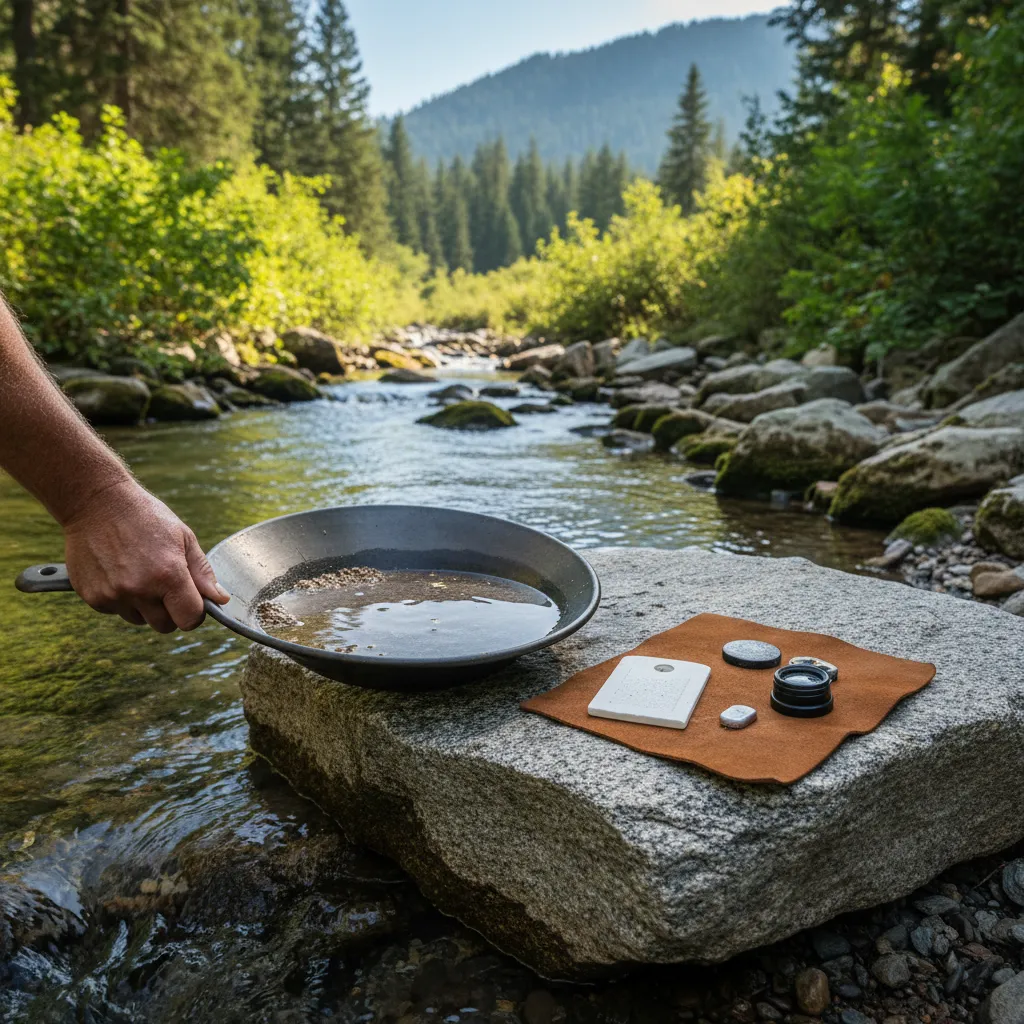
If you’re out in the field trying to figure out whether that rock in your hand is worth carrying home, the tests below will help — whether you’re looking at placer gold in a pan or gold ore in hard rock.
The Streak Test (Do This One First)
This is the single most reliable field test, and it takes about three seconds.
Grab a piece of unglazed ceramic — the back of a bathroom tile works, or you can buy a streak plate from a geology supply shop for a few bucks. Drag your mystery mineral across the surface with firm pressure.
Real gold leaves a gold-colored streak. Same warm yellow as the piece itself, every time.
Pyrite leaves a dark greenish-black streak. Doesn’t matter how gold it looks in your hand — the streak gives it away immediately.
I keep a small piece of unglazed tile in my prospecting kit specifically for this. It’s maybe 2 inches square, weighs nothing, and it’s saved me from embarrassing myself more times than I want to admit. If you only remember one test from this article, make it this one.
How to Identify Gold in Rocks: What to Look For
When you’re hiking through mining country or poking around abandoned mine sites, knowing how to identify gold in rocks comes down to understanding mineral associations. Gold doesn’t show up randomly — it hangs out with specific minerals and rock types.
Indicator Minerals and Colors
The rocks most likely to contain gold share a few telltale traits:
- Iron staining (red/orange/brown): Hematite and limonite staining on rock surfaces means hydrothermal fluids passed through. Where iron went, gold often followed. That rusty red coloring on rock faces near old mines? That’s hematite, and it’s one of the most reliable visual indicators of mineralization.
- Dark sulfide bands: Black material in or alongside quartz veins usually means sulfides — pyrite, arsenopyrite, galena. Gold is frequently “locked up” in these sulfide minerals. When these sulfide-bearing rocks weather and break down, they become extremely brittle.
- Quartz veins: The number one host rock for gold. If you see white quartz running through darker rock, pay attention. More on this below.
- Fault gouge and shear zones: Broken-up, soft rock along fault lines indicates that mineral-rich fluids traveled through these fractures and deposited minerals — including gold. USGS reports frequently reference fault gouge when describing gold deposits.
The Weight Test for Ore
Gold ore is noticeably heavier than it looks. Field samples described by experienced prospectors range from 6–7 pounds for modest rocks up to 20+ pounds for larger specimens. If you pick up a dark, iron-stained rock and it feels surprisingly heavy, that’s worth investigating further.
One extreme example: a boulder found in the 1970s weighed 114 pounds and contained an estimated 300+ ounces of gold. Most of us won’t find anything close, but the principle holds — gold-bearing rock is dense.
How Gold Gets Into Rocks
Understanding the geology helps you know where to look. Gold typically travels in ionic form through superheated hydrothermal fluids deep underground. When these fluids hit changes in temperature, pressure, or pH, the gold drops out of solution and deposits into the surrounding rock.
This is why gold concentrates in specific spots:
- Where hot fluids meet cooler rock (contact zones)
- Along fault lines and fractures
- In replacement deposits where fluids literally swap out the original rock minerals
- At the intersection of multiple vein systems
Across the United States, these geological conditions created gold deposits in dozens of states — you can explore gold mine data by state to see exactly where historic and active mines are concentrated.
How to Identify Gold in Quartz
Quartz veins are the classic home for gold ore, and learning how to identify gold in quartz is one of the most practical skills a prospector can develop. Gold and quartz are found side by side so consistently that veteran miners say dark mineralization bands running alongside quartz will contain gold “99.99% of the time.”
What to Look For in Quartz
Color contrast is your friend. Gold in quartz appears as bright yellow metallic flecks, wires, or sheets set against white or milky quartz. The contrast makes even small gold particles visible to the naked eye.
Check where sulfide meets quartz. Multiple experienced ore analysts note that gold commonly appears at the boundary where sulfide minerals (the dark, dull material) meet quartz (the white mineral). If you cut or break a piece of quartz ore, look specifically at these transition zones.
Examine vugs and cavities. Small openings within quartz veins are prime gold habitat. Gold can form dendritic (tree-like) crystals and spongy textures in these pockets where it precipitated out of hydrothermal fluids.
Practical Examination Steps
- Look at the raw surface first — but don’t trust it. Free gold in uncut ore is extremely difficult to spot on weathered surfaces.
- Break the rock on a fresh surface — slightly better, but still unreliable for fine gold.
- Cut with a rock saw if possible — this dramatically reveals mineral associations and gold flecks that were invisible before.
- Use magnification — a 10x loupe works, but even a cheap 200x phone-clip microscope can reveal fine gold invisible to the naked eye.
- Examine in direct sunlight — reflected sunlight causes gold to “flash” yellow against the host rock in a way that artificial light doesn’t replicate.
Not all quartz contains gold, obviously. But if you find quartz with iron staining, sulfide minerals, and it came from a known gold-producing area, it’s worth a closer look.
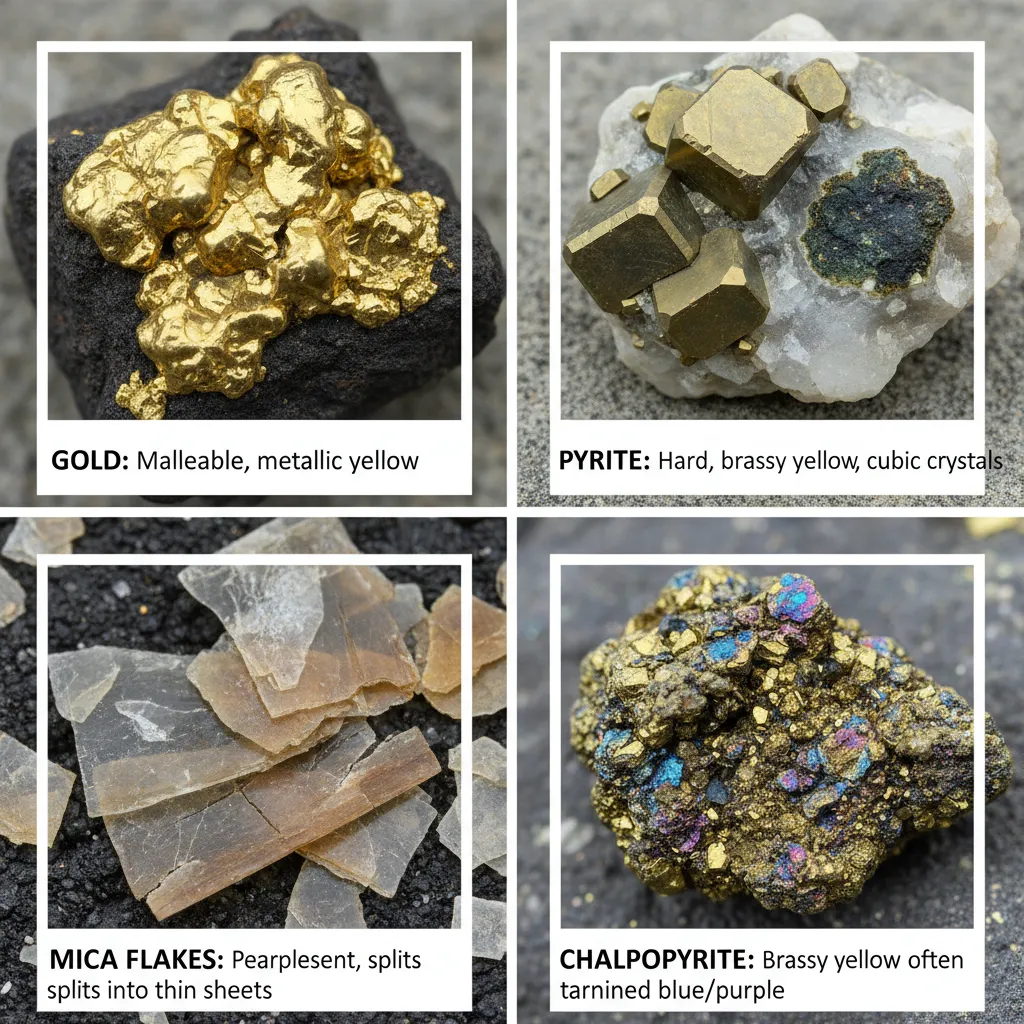
Gold vs Pyrite: The Visual Differences
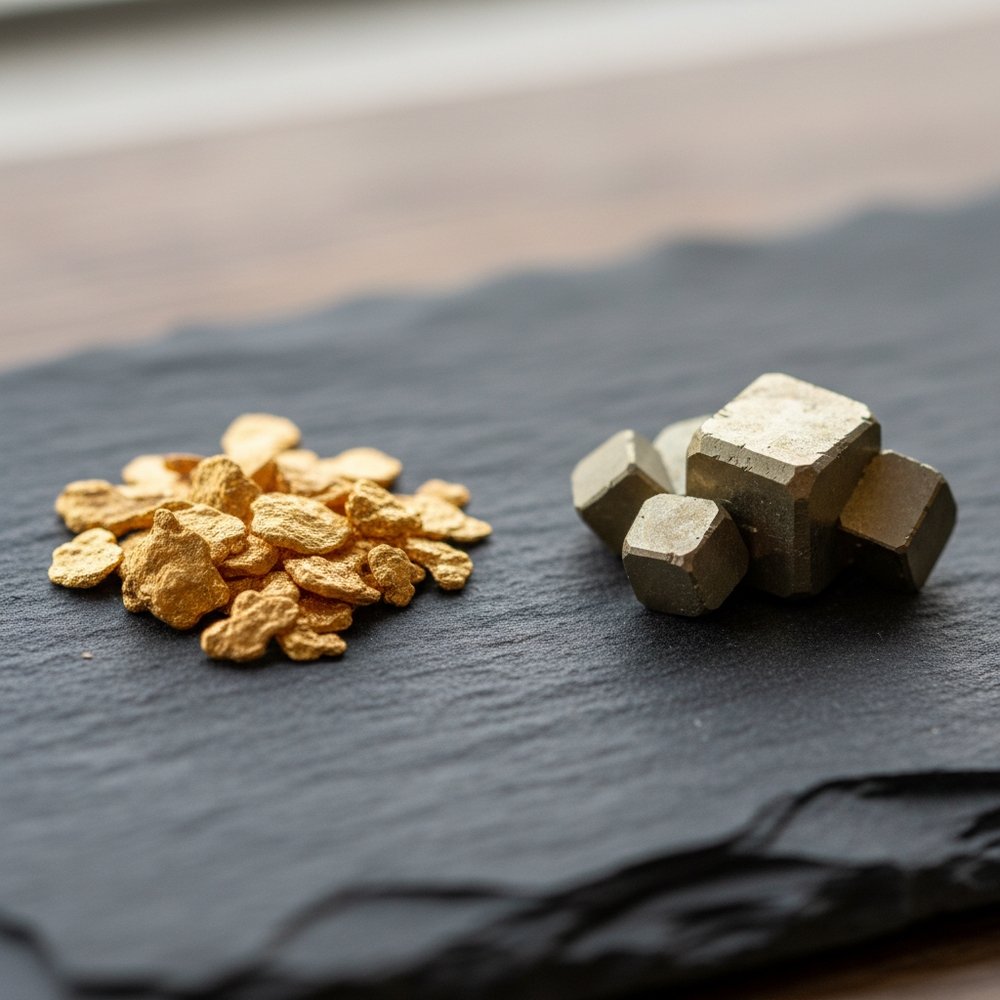
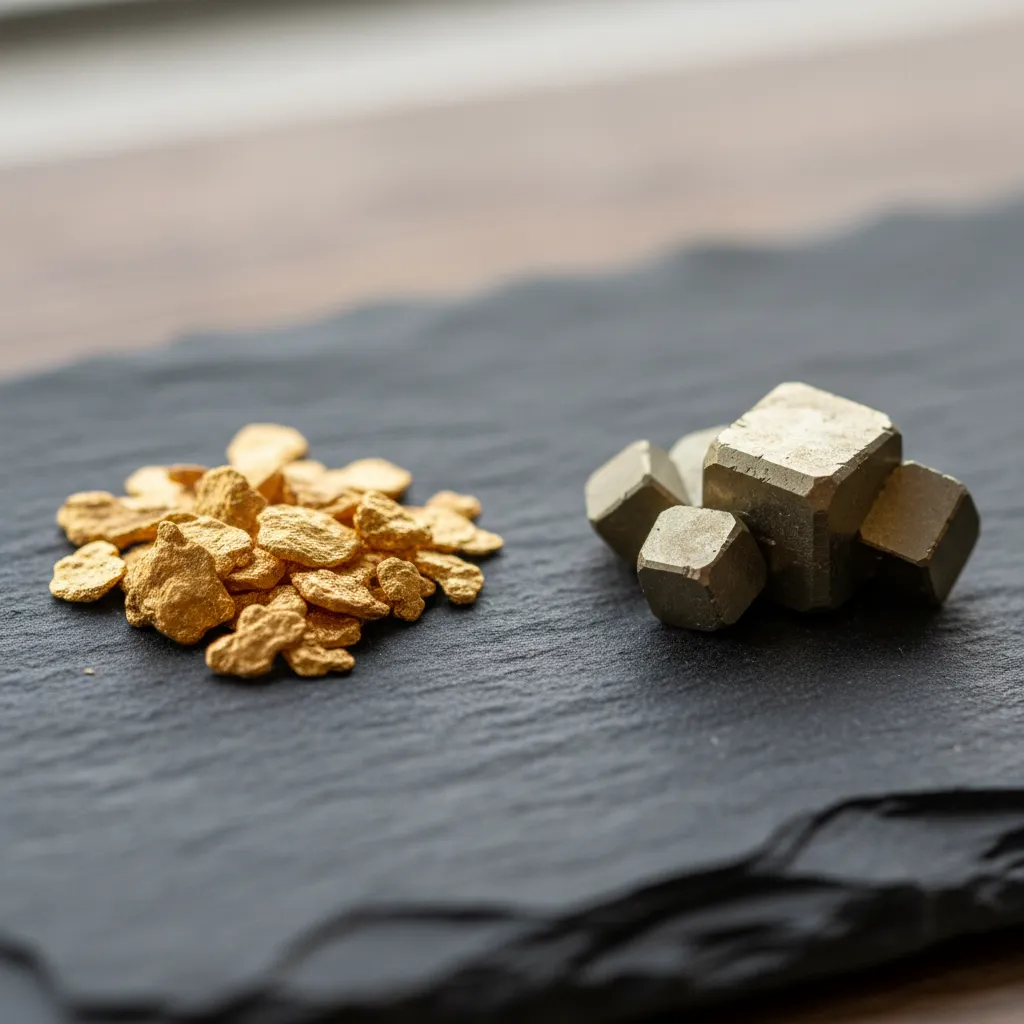
Once you’ve seen real gold and pyrite side by side, the difference is obvious. The problem is your first time out, you haven’t seen them side by side. Everything yellow looks like gold when you want it to be gold.
Here’s what to look for:
Color
Real gold is a warm, buttery yellow that looks the same whether you’re in direct sunlight or shade. Rotate it, move it around — the color stays consistent. It has this rich, almost soft quality to it that’s hard to describe until you’ve seen it.
Pyrite is brassier. It has a metallic, slightly greenish tint, especially in sunlight. If the color shifts depending on the angle or looks “too shiny” — like costume jewelry rather than the real thing — it’s probably pyrite. One jeweler I watched on YouTube described real gold as having a “soul” compared to the flat shininess of fakes. Sounds dramatic, but once you see the difference, you’ll know exactly what he meant.
Shape
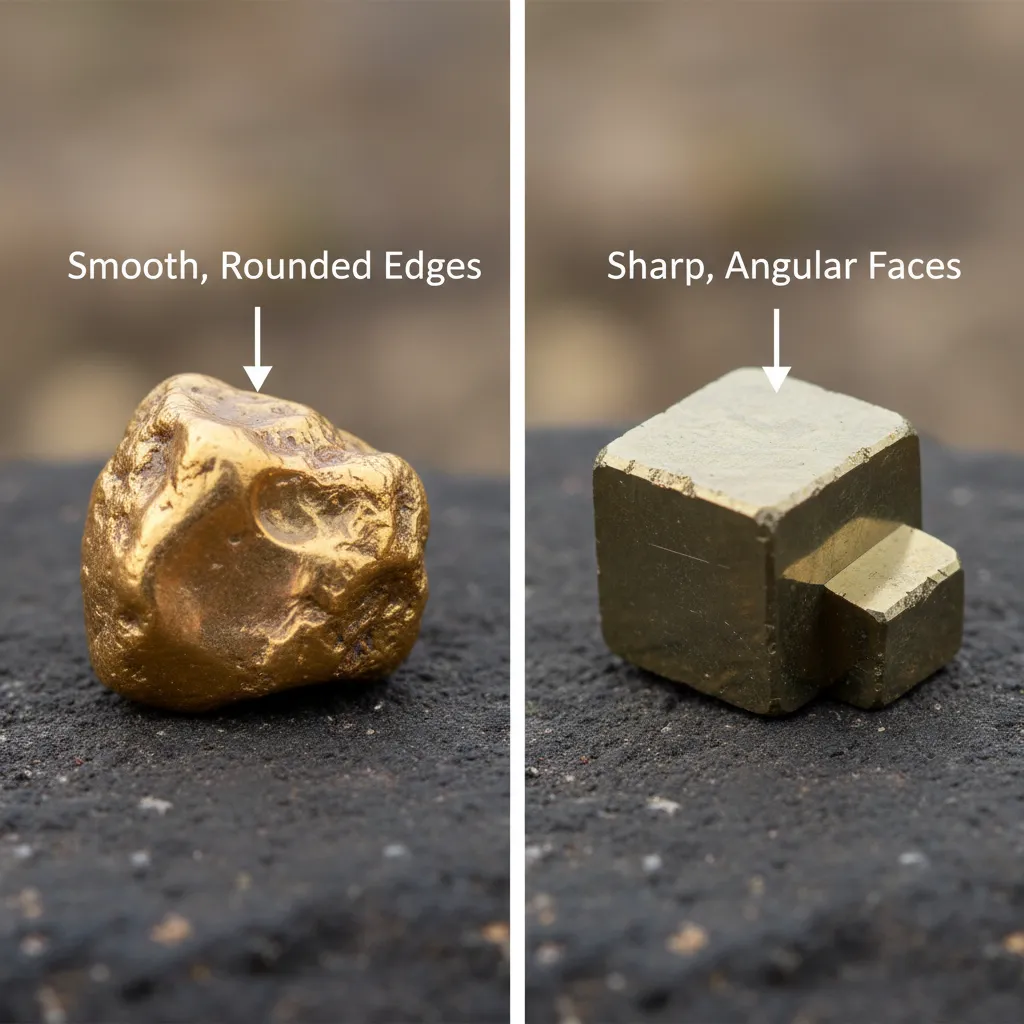
This one’s huge for placer gold specifically. Gold that’s been tumbling through creeks and rivers gets beaten into smooth, rounded shapes. Flakes, nuggets, wires — they all have soft edges from years of water erosion. Think of how river rocks get rounded over time. Gold does the same thing.
Pyrite forms angular, geometric crystals. Cubes, octahedrons, sharp edges. Nature doesn’t tumble pyrite into smooth shapes the way it does with gold. If your piece has defined crystal faces and sharp corners, that’s your answer right there.
Weight
Gold is absurdly dense — 19.3 g/cm³, which means it’s about 19 times heavier than water. Pick up a piece of real gold and it feels wrong for its size, like someone snuck lead into it. A piece of gold the size of a golf ball weighs roughly 4 pounds.
Pyrite has a specific gravity of about 5.0. Still heavier than most rocks, but nowhere close to gold. If you’re panning in a creek and your shiny flakes are floating around with the black sand instead of sitting dead on the bottom of the pan, they’re not gold. Real gold drops like it’s bolted to the pan floor.
The Hardness Test
Gold is soft. Surprisingly soft. Pure 24K gold has a Mohs hardness of about 2.5, which means you can dent it with a fingernail if the piece is big enough. Even alloyed gold (14K, 18K) is relatively soft compared to most minerals.
The fingernail test: Press your fingernail into the piece. Real gold will show a slight indentation. Pyrite won’t budge — it has a Mohs hardness of 6 to 6.5, which puts it harder than a steel knife blade.
The smash test: This one’s definitive but destructive, so only do it if you don’t care about preserving the piece. Put the sample on a hard surface and tap it with a rock or hammer. Gold is malleable — it flattens, deforms, squishes. It bends without breaking. You can hammer a gold flake thinner and it won’t shatter.
Pyrite is brittle. It shatters into angular fragments and gives off a sulfur smell (rotten eggs). If your “gold” crumbles when you tap it, congrats — you’ve made smaller pieces of not-gold.
I learned this lesson at a creek near Breckenridge when I tried to flatten a “nugget” with a rock and it exploded into a dozen pieces. The sulfur smell hit me about half a second later. That one didn’t even make it into the jar.
The Magnet Test
This one’s quick but limited. Hold a strong magnet (neodymium magnets work best) near your sample.
Gold is not magnetic. It won’t react to the magnet at all.
Pyrite is weakly magnetic in some forms, but honestly, most pyrite won’t stick to a magnet either. So a negative result doesn’t prove anything. But if your sample IS attracted to a magnet, you can rule out gold immediately. I keep a small rare-earth magnet on my keychain. Takes two seconds to check and eliminates the obvious fakes.
Where this test really shines is with gold-plated items or fake gold jewelry. Lots of costume jewelry uses a steel base with gold plating. A magnet pulls it right off the table.
Other Minerals That Fool People
Pyrite gets all the fame as “fool’s gold,” but it’s not the only impostor out there. Here are the other common ones I’ve been tricked by or seen others mistake for gold:
Mica
Mica flakes are thin, shiny, and golden-colored. They’re everywhere in creek beds and they catch the light beautifully. The difference: mica is paper-thin, flexible, and basically weightless. It floats on water. Real gold doesn’t float. Ever.
If you’re panning and seeing tons of glittery flakes that ride the water surface instead of sinking, that’s mica. I still see it every single trip and for about half a second my brain goes “GOLD” before the rational part catches up.
Chalcopyrite
Chalcopyrite is copper iron sulfide and it looks more like gold than pyrite does, in my opinion. It has a deeper yellow color and a metallic luster that’s genuinely close to the real thing. The giveaway: it tarnishes to iridescent blues and purples. If your sample has any rainbow-colored oxidation on it, it’s chalcopyrite. Streak test shows greenish-black, same as pyrite.
Biotite
Biotite is a dark mica mineral that sometimes appears golden-brown and sparkly in certain light. It’s flaky, lightweight, and crumbles easily. Not a convincing gold substitute once you pick it up, but in the pan under water it can catch your eye for a second.
Types of Gold Deposits (Know What You’re Looking At)
Not all gold ore forms the same way, and knowing the deposit type helps you identify what to look for in a specific area. Here are the most common types you’ll encounter as a prospector:
Epithermal Deposits (Near-Surface)
These form around ancient hot springs and geothermal systems. They’re relatively shallow and produce some of the highest-grade gold ores. Nevada is famous for epithermal gold — the thin crust in that region created ideal conditions. Visual clue: Rock looks pitted or acid-eaten, with feldspars dissolved into soft clays.
Orogenic / Mesothermal Deposits (Deep Vein)
The classic “mother lode” type. Created by mountain-building events that squeezed gold-bearing fluids into near-vertical quartz veins. California’s Sierra Nevada gold belt is the textbook example. These are the deposits that drove the 1849 Gold Rush and the ones you’re most likely to encounter in historic mining regions.
Intrusion-Related Deposits (Contact Zones)
These occur where granite meets limestone, creating a reaction zone called metasomatism. Visual clue: Decomposing granite against gray limestone with red limonite between them. The gold in these deposits is native and crystalline, found in the limonite — not in quartz. This throws off prospectors who only look for gold in quartz veins.
Placer Deposits (Eroded and Transported)
When any of the above deposit types erode over millions of years, the gold gets carried downstream and concentrated in rivers, creeks, and ancient river channels. This is the gold you find when panning — already liberated from its host rock by natural weathering. Understanding the source deposit helps you trace placer gold upstream to its origin.
How to Identify Gold Ore: Your Field Testing Kit
After getting fooled enough times, I put together a small testing kit that lives in my pack. Total cost was maybe $15:
- Unglazed ceramic tile (streak test) — the single most useful item
- Small neodymium magnet — quick elimination test
- 10x hand lens / jeweler’s loupe — seeing crystal structure vs smooth surfaces, spotting fine gold in quartz
- Steel nail or knife — hardness comparison (steel is about 5.5 on Mohs scale; gold is softer, pyrite is harder)
- Small rock hammer — for breaking open suspicious quartz to check fresh surfaces
Some people carry acid test kits in the field. I don’t. Nitric acid is corrosive, destroys part of the sample, and honestly if a piece passes the streak test, shape check, and hardness test, I’m confident enough to take it home. You don’t need acid on the riverbank. Save that for the workshop.
If you’re just getting started building out your gear, I put together a full gold panning equipment guide that covers everything from basic pans to advanced setups. And once you’ve confirmed you’re finding real gold ore, you’ll want to understand your options for extracting and processing it.
When to Get a Professional Assay
If you find something substantial — a piece big enough to hold between your fingers, or you’re consistently pulling color from a spot and want to know the purity — get it assayed.
A fire assay is the gold standard (pun intended) for determining exact gold content. A lab melts your sample and separates the metals. Costs typically run $30 to $75 per sample depending on the lab and what you’re testing for.
An electronic tester at a jeweler is faster and cheaper (sometimes free if you ask nicely). These measure electrical resistance to estimate karat purity. Decent for jewelry but less precise for raw gold ore with lots of impurities.
You’ll want an assay if:
- You’ve found gold ore and want to know the grade before investing serious time
- You have a nugget and want to determine karat/purity before selling
- You found something that passes all your field tests but still looks unusual
- You’re finding consistent color in a new area and want to evaluate whether it’s worth a mining claim
Quick Reference: Gold vs Pyrite vs Common Lookalikes
| Test | Gold | Pyrite | Mica | Chalcopyrite |
|---|---|---|---|---|
| Streak | Gold/yellow | Greenish-black | White | Greenish-black |
| Hardness | 2.5 (soft) | 6-6.5 (hard) | 2-3 (soft, flexible) | 3.5-4 |
| Shape | Smooth, rounded | Angular crystals | Flat, flaky sheets | Irregular masses |
| Density | 19.3 g/cm³ | 5.0 g/cm³ | 2.8 g/cm³ | 4.2 g/cm³ |
| Magnetic | No | Weakly | No | No |
| Smash test | Flattens | Shatters (sulfur smell) | Peels apart | Shatters |
| In quartz | Yellow metallic flecks | Brassy cubic crystals | Shiny sheets | Deep yellow, tarnishes |
Stop Second-Guessing Yourself
Here’s what I’ve learned after years of prospecting and way too many pyrite incidents: knowing how to identify gold ore gets easy fast. After your third or fourth trip to a gold-bearing river, you’ll develop an eye for it. Real gold has a quality that’s hard to put into words but impossible to miss once you’ve trained your brain to see it.
My advice: bring a known piece of gold with you to the creek. Even a tiny flake in a vial. When you find something questionable, hold it up next to your reference piece. Compare the color, the luster, the weight. Within a few trips, you won’t need the comparison anymore.
And whether you’re finding placer flakes in a pan or cracking open quartz veins in hard rock country, the same fundamentals apply. Learn the streak test, understand mineral associations, and trust the weight. Gold doesn’t lie — the rock it lives in might look ugly, but the metal itself is unmistakable once you know what you’re looking at.
And if you do accidentally collect a jar of pyrite and show it to your friends? Just own it. We’ve all been there. Even Gene — the retired prospector who taught me how to pan at Clear Creek — told me he came home with a pocket full of mica his first time out. “Worst part was I’d already called my wife from the payphone to tell her I was rich,” he said. He didn’t elaborate, but I got the sense dinner was quiet that night.