Published
- 23 min read
What Is Placer Gold? The Complete Guide to Finding It
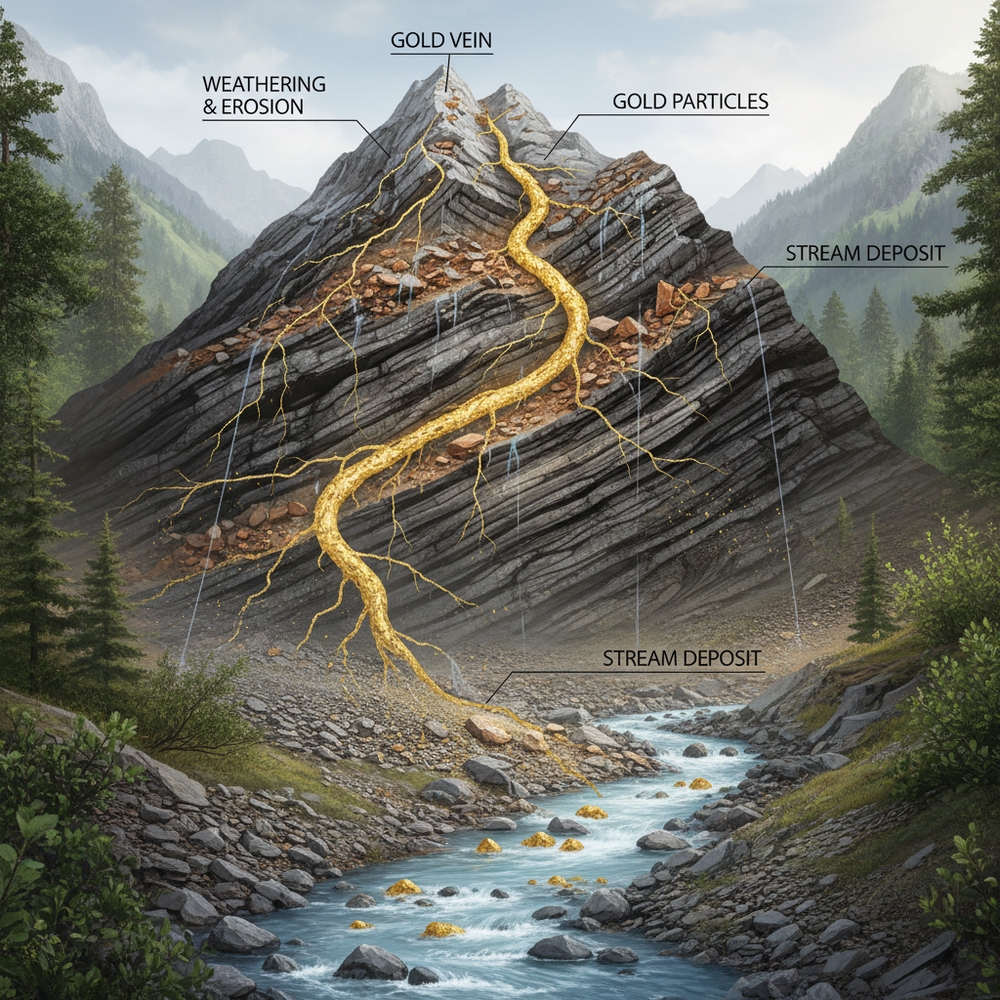
Placer gold is loose gold that’s been freed from rock and deposited in streams, rivers, and ancient waterways by the force of moving water. It’s the gold you can find with a pan, a sluice box, or even your bare hands — no dynamite or heavy equipment required.
The word comes from Spanish (“placer” meaning sandbank), and understanding what placer gold actually is — how it forms, how water moves it, and where it piles up — is the difference between finding gold and just getting your feet wet. This guide covers everything from the geology behind placer deposits to the practical methods for recovering gold from them.
How Placer Gold Forms: The Science of Erosion and Density
Gold starts locked inside quartz veins and sulfide minerals deep in mountains. Over millions of years, weather does the work for us. Freeze-thaw cycles crack the rock. Rain dissolves softer minerals. Roots pry apart boulders. Sulfides oxidize and rust away, releasing the gold trapped inside them. Eventually, chunks of gold-bearing quartz break free and tumble into creeks. Water grinds away the quartz, and the gold — being incredibly dense — sinks to the bottom of whatever waterway it lands in.
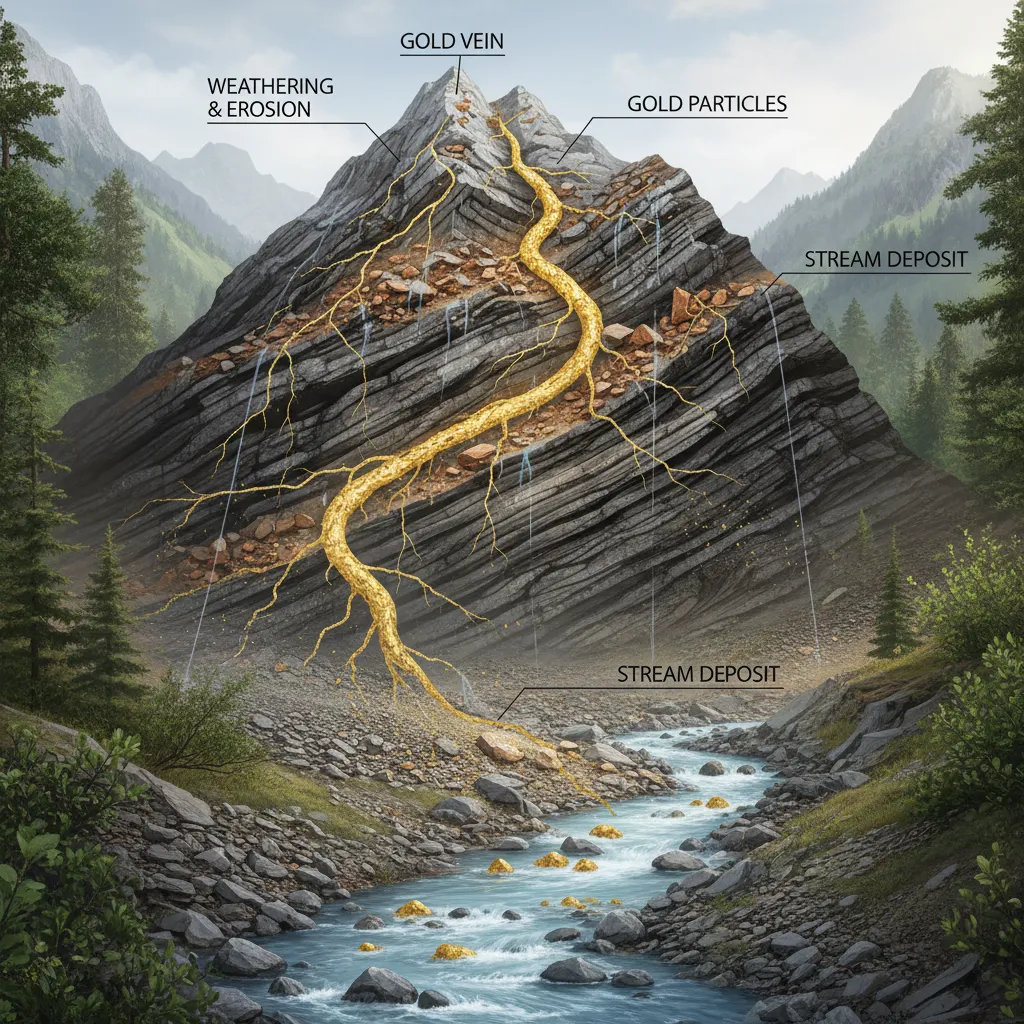
Here’s what makes gold weird: it’s 19.3 times denser than water and about 7 times denser than the sand and gravel around it. For perspective, a golf ball-sized piece of gold weighs about 4 pounds. That density means gold behaves completely differently than everything around it. While sand and gravel wash downstream during floods, gold drops out of the current fast. It works its way down through gravel until it hits bedrock and gets stuck.
That’s your placer deposit. Nature pre-concentrated it for you. Your job is to find where it piled up and get it into a pan.
Types of Placer Gold: From Flour Gold to Nuggets
Not all placer gold looks the same. Prospectors classify it by size, and knowing the terminology helps you understand what you’re finding and how close you might be to a rich deposit.
Flour gold (also called fine gold) — Tiny particles smaller than a pinhead, often less than 0.1mm. This is the most common form of placer gold and the hardest to recover. It floats on surface tension if you’re not careful with your pan technique. Flour gold usually indicates you’re far from the source or working in a deposit where the gold has been heavily processed by water over long periods.
Flake gold — Flat, thin pieces roughly 1-3mm across. This is what most recreational prospectors find. Flakes form when gold gets hammered between rocks in the streambed over time. They’re easy to spot in a pan and satisfying to collect, though you’ll need a lot of them to accumulate any weight.
Picker gold — Pieces large enough to pick up with your fingers, typically 3-7mm. Finding pickers is a good day. They’re heavy enough that they don’t travel far from their source, so pickers often mean you’re getting closer to a concentration.
Nuggets — Any piece over about 7mm, though the term loosely applies to anything you’d call a “piece” rather than a “speck.” Nuggets are rare in most placer deposits. When you find one, it usually hasn’t traveled far from its lode source — the size and weight prevent long-distance transport.
The shape tells a story. Round, smooth, hammered-flat pieces have been tumbling in water for a long time — possibly miles from their origin. Rough, angular, chunky pieces with sharp edges and maybe some quartz still attached are close to home. If your gold gets rougher and chunkier as you work upstream, you’re tracing it back toward the source.
Placer Gold vs Lode Gold: Key Differences
This distinction matters more than most beginners realize, because the type of gold you’re looking at tells you how far it traveled — and that tells you how close you might be to the motherlode.
Lode gold (also called hard rock gold) is gold still embedded in its original rock source. It’s jagged, sharp, sometimes crystalline, and often has quartz or other host rock still attached. Most lode gold is extremely fine — 100 to 400 mesh, meaning you’d need a microscope to see individual grains. This is the gold that commercial mining operations blast and crush out of mountains.
Placer gold is lode gold that’s been weathered free and transported by water. The farther it travels from its source, the more its appearance changes:
| Distance from Source | Shape | Surface | What It Tells You |
|---|---|---|---|
| Near source (eluvial) | Jagged, angular | Rough, may have rust stains from sulfides | You’re close to the vein — look uphill |
| Short travel | Slightly rounded, some structure | Smoother, less quartz attached | Source is within a few hundred yards |
| Far traveled | Flat flakes, hammered smooth | Highly polished, no attachments | Gold has been in the river system a long time |
When you find rough, jagged gold with sharp edges and rust staining, pay attention. That gold hasn’t gone far. The lode source could be just uphill from where you’re standing. When you find paper-thin, perfectly smooth flakes, the gold has been tumbling between rocks for potentially thousands of years and could have traveled miles from its origin. This technique of tracing placer gold upstream to its lode source is how many of history’s biggest gold discoveries were made.
How Water Concentrates Placer Gold
Understanding placer gold is really about understanding hydrodynamics — how moving water sorts heavy materials. A streambed is nature’s sluice box. The riffles in your pan or sluice are just artificial imitations of what rivers do naturally.
Here’s the physics: anytime water changes speed or direction, heavy materials drop out of the flow. Gold, being the densest thing in the stream, drops first. Three situations cause this consistently:
Low-pressure zones behind obstacles. When water flows around a boulder or bedrock outcrop, a calm pocket forms on the downstream side. Water pressure actually drops there, pulling gold into the pocket. This is why you find gold behind big rocks — the physics literally suck it into place.
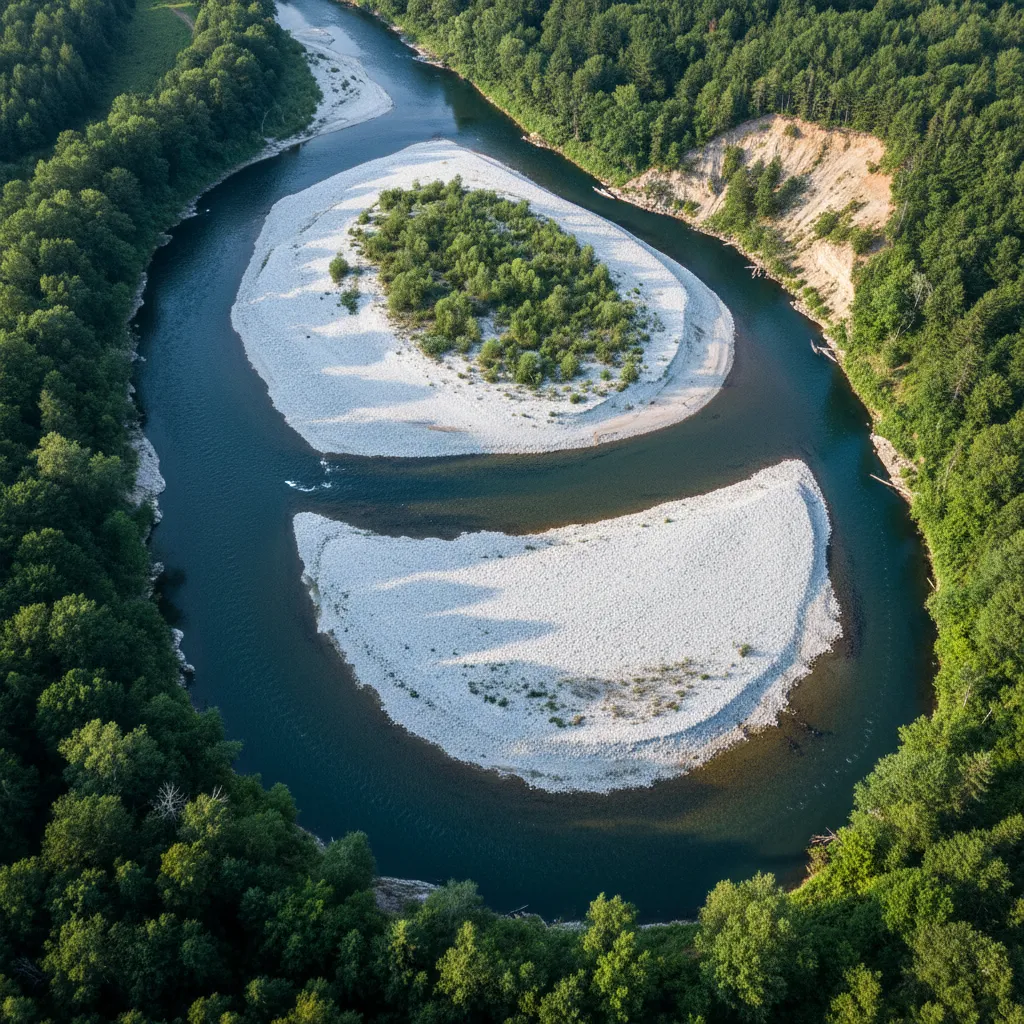
Speed drops at bends. Water races along the outside of a stream bend and crawls along the inside. Where the velocity drops below the threshold needed to carry gold, it falls out of suspension and deposits. The classic “inside of the bend” rule.
Helical flow patterns. Here’s something most prospectors never learn: water in a stream doesn’t just flow forward. It moves in a coiled, corkscrew pattern — fast on the surface, slower along the bottom, spiraling from the outside of bends toward the inside. This helical flow acts like a natural concentrator, sweeping gold along the streambed toward the inside edges of curves. The pay streak — the line where gold concentrates most heavily — traces an S-curve pattern, cutting across the inside tips of bends from mountains to the sea.
One thing experienced prospectors know: the “inside of the bend” rule isn’t always correct for the current stream channel. Floods from hundreds or thousands of years ago can deposit gold on unexpected sides of a creek. Look for ancient flow indicators — high benches with rounded cobbles, old gravel terraces above the current waterline, degraded stumps in areas that are now high and dry. Those ancient channels can hold gold deposited by rivers that no longer exist.
Types of Placer Deposits
Not all placer gold ended up in an active stream. Geologists classify placer deposits by how far the gold traveled from its source:
Residual placers — Gold weathered free from a vein but still sitting on top of or very near the parent rock. Basically, the quartz rotted away and the gold is just lying there. These form on hillsides and ridgetops above the original vein.
Eluvial placers — Gold that moved a short distance downhill by gravity and soil creep, but never entered a stream. Found on slopes below the lode source. The gold is angular and rough because water hasn’t tumbled it smooth.
Alluvial placers — The classic stream deposit. Gold transported and concentrated by flowing water in active or recent stream channels. This is what most recreational prospectors target, and it’s what people usually mean when they say “placer gold.”
Bench placers — Ancient alluvial deposits left stranded above the current stream level when the river cut deeper into its valley over time. Those 1849 miners were pulling nuggets from bench placers — ancient channels running 200 feet above the current creek. The rivers are long gone but the gold is still sitting in the old gravels.
Beach placers — Gold concentrated by ocean wave action along shorelines. Nome, Alaska made this famous — miners literally panned the beach sand.
Knowing these types matters because it tells you where to look beyond the obvious streambed. If you find rough, angular gold on a hillside above a creek, you might be standing on an eluvial deposit with a lode source directly uphill.
Where Placer Gold Collects in Streams
I spent months going through USGS data and historic mining records building a map because my buddy Ryan thought I was insane. “You’re building a spreadsheet instead of actually going outside?” he said, which was fair because I was sitting at my kitchen table with three monitors and a bag of Doritos while he was heading to the creek. But the patterns in that data changed how I prospect, and Ryan stopped making fun of me after I found a spot he’d been driving past for years.
Inside bends of streams. Water moves fast on the outside of a curve and slow on the inside. Gold drops where the current slows. This is the most reliable rule in prospecting. Every time I walk up to a new creek, the first place I pan is the inside of the first bend I see. It works more often than it doesn’t. For the full breakdown on reading water, check out how to find gold in rivers.
Behind big rocks. Any boulder creates a dead zone on its downstream side. Gold settles there. Last October on Clear Creek in Colorado, I spent an hour on a gravel bar finding nothing. Just killing time, really, eating a sandwich on a boulder and thinking about whether I should give up and go to the brewery in Idaho Springs instead. Then I realized I was sitting on the kind of obstruction that creates exactly the dead zone I’m describing. Dug behind it. Three pans in a row had visible color. I’d been sitting on top of it eating my lunch like an absolute genius.
Bedrock cracks. Once gold reaches bedrock, it’s trapped. Crevices running across the current are basically nature’s riffle system — they work the same way the riffles in your pan do. Clean them out with a screwdriver or crevicing tool. Some of my best finds have come from cracks that looked like nothing special. Cracks perpendicular to the current trap significantly more gold than those running with the flow — the physics are the same as riffles in a sluice box.
Old river channels. Rivers move over time, and ancient bench placer deposits can sit hundreds of feet above the modern stream. The gold just waits in those old gravels for someone to figure out it’s there.
Below boulders that only move in major floods. A rock that stays put for decades between hundred-year flood events accumulates gold underneath it the entire time. If you can safely move cobbles and boulders in a known gold-bearing stream, check beneath them.
One critical detail: you can be within one foot of a serious gold concentration and find almost nothing. The pay streak in a stream is narrow. Three feet away from a rich deposit, you’ll typically only get a few colors per pan. That’s why sampling across the stream — perpendicular to the flow — is so important. Don’t just dig lengthwise along the bank.
How to Identify Placer Deposits Using Geological Maps
You don’t have to stumble onto gold by accident. USGS geological maps and historical mining records can tell you exactly where to look before you ever get your boots wet.
Start with USGS mineral resource maps. The USGS maintains the Mineral Resources Data System (MRDS) with records of over 300,000 mineral occurrences across the US. Each entry includes location coordinates, commodity type, deposit type, and often historical production data. Filter for gold occurrences classified as “placer” and you’ve got a map of known deposits. You can explore these on the GoldFever.app mine map — I compiled over 75,000 mine sites and mineral occurrences from these records.
Read geological survey maps for indicator formations. Gold-bearing placer deposits are almost always downstream of known lode sources. On a geological map, look for:
- Quartz vein systems (shown as thin lines in metamorphic or igneous rock)
- Greenstone belts and other metamorphic terranes associated with gold mineralization
- Alluvial deposits marked on surficial geology maps — these are the gravel, sand, and cobble deposits that may contain placer gold
- Historical mining districts — if hard rock mines operated in an area, the streams below them almost certainly received placer gold
Check topographic maps for bench deposits. Look for flat terraces or benches above current stream levels. These often represent ancient river channels that may contain bench placer deposits. USGS 7.5-minute topographic maps show these features clearly with contour lines.
Cross-reference with historical records. State geological survey reports from the late 1800s and early 1900s are gold mines of information (pun intended). They document which creeks produced placer gold, estimated yields per cubic yard of gravel, and the geological formations that sourced the gold. Many of these reports are digitized and freely available.
Use the state-by-state mine data to narrow your search area, then zoom in with geological maps for specific streams and formations.
Indicator Minerals: Black Sand, Garnets, and Other Clues
You don’t need to see gold to know it’s nearby. Certain minerals travel with gold and concentrate in the same places, acting as pathfinders that tell you you’re in the right neighborhood.
Black sand (magnetite and hematite) is the most important indicator. When you pan down to a layer of heavy black sand, that’s magnetite — an iron oxide mineral with a density of about 5.2 g/cm³. It concentrates in the same traps as gold because it’s denser than regular sand. Heavy black sand concentrations mean your pan is working correctly and you’re sampling in a spot where heavy minerals accumulate. No black sand usually means the hydrology isn’t concentrating heavies there — move on.
Garnets appear as small red, pink, or orange grains in your pan. They’re denser than most sand (3.5-4.3 g/cm³) and often associate with gold-bearing metamorphic rock. A pan full of garnets tells you the source material is the right type of geology for gold.
Other indicators to watch for:
- Lead shot and old mercury — signs that historic miners worked the area (where there’s old-timer activity, there’s gold)
- Rusty iron staining in gravel — can indicate sulfide-bearing rock upstream, the same formations that host gold
- Small platinum or palladium grains — rare, but found alongside placer gold in some western US deposits
- Heavy green or black minerals (chromite, ilmenite) — common in the heavy mineral fraction alongside gold
Think of it this way: gold is shy. It doesn’t always show up on the first pan. But its friends are loud. If you’re seeing lots of black sand, garnets, and other heavies, you’re in a spot where gold could concentrate — keep sampling.
How to Tell Real Gold from Pyrite
I have a jar of pyrite on my desk that I excitedly collected on my first trip to the Yuba River in California. I showed it to my wife when I got home like a kid showing off a school art project. She said “that’s nice, honey” in the voice she uses when she’s trying not to laugh. It took me two days of googling to figure out I’d collected a jar of iron sulfide. For the complete breakdown, I wrote a whole guide on how to identify gold vs pyrite.
Here’s the quick version:
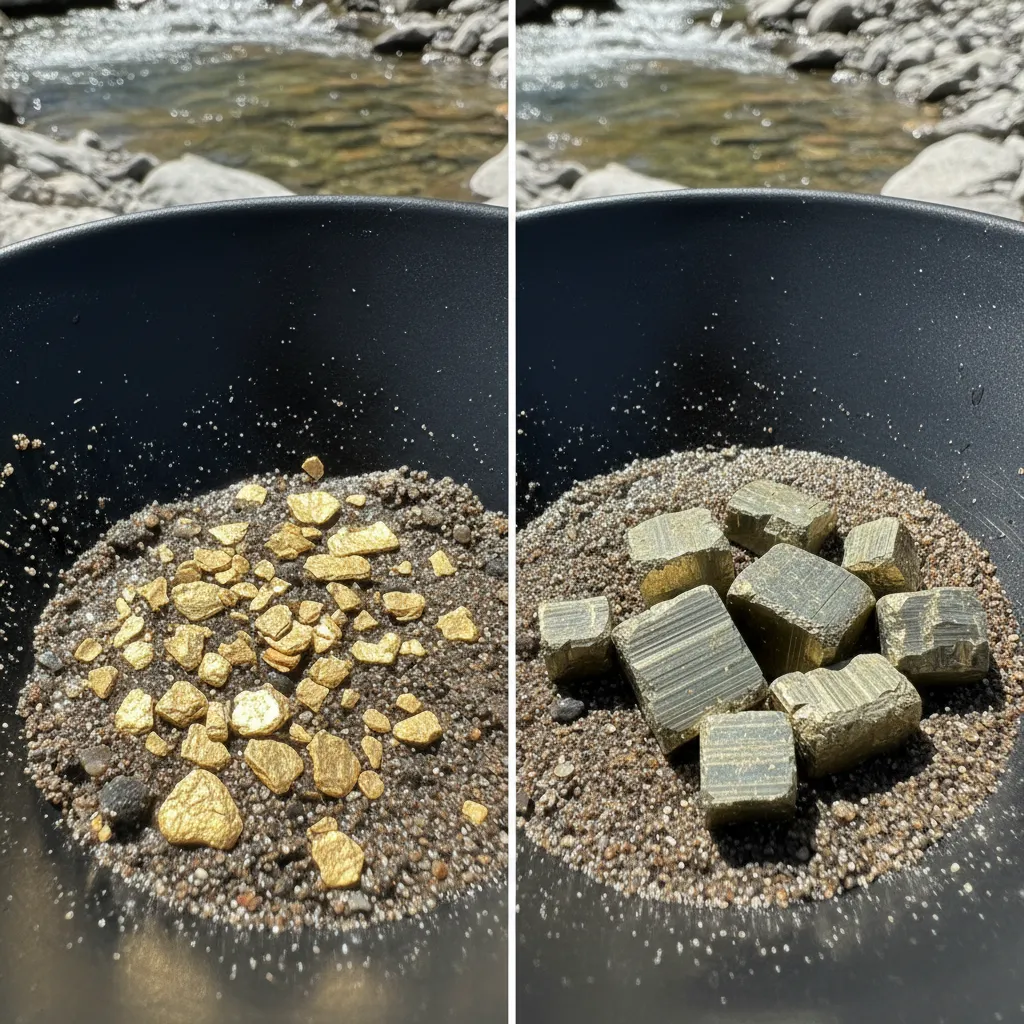
Real gold stays the same warm yellow color in any light. You can flatten it without shattering it — try pressing it with a fingernail, and if it dents, it’s gold. It sinks immediately to the bottom of your pan. It has smooth, rounded edges from tumbling in water.
Pyrite has a brassy, sometimes greenish tint. It shatters when you hit it. It forms angular crystal shapes, not smooth curves. And it’s way lighter than it looks.
The weight test is foolproof. When you swirl your pan — I use a Garrett 14-inch green pan, about twelve bucks, been using the same one for three years — gold moves like it’s glued to the bottom while everything else washes over it. Pyrite and mica flutter around like they can’t make up their minds.
Where to Find Placer Gold in the United States
California’s Sierra Nevada foothills are the classic answer. The Yuba, American, and Feather Rivers were ground zero for the Gold Rush and they’re not empty yet. I’ve found gold there myself.
Alaska — if you can get there and handle the cold. Colorado — Clear Creek near Denver is accessible and productive, and the San Juan Mountains have serious deposits. Arizona — Lynx Creek near Prescott is the go-to winter spot. Oregon and Idaho’s Rogue River system and Boise Basin get less attention, which mostly just means fewer people competing for the gold.
Here’s what I actually want to say though: people sleep way too hard on the Southeast. Georgia and the Carolinas have legitimate placer deposits and almost nobody works them. I pulled more color per pan on the Chestatee River in Dahlonega, Georgia than I have on some overpicked California creeks. The Appalachian gold belt runs from Georgia through Virginia and it gets a fraction of the prospecting pressure that western streams get. Fight me on that one.
Check the best gold prospecting locations for a full breakdown by region, or browse the GoldFever.app map to find documented deposits near you. For a deeper look at where gold is found across the United States, I mapped out the major gold-bearing regions with data from USGS records.
How Do You Mine Placer Gold? Methods Explained
Placer mining methods range from a $12 pan to six-figure dredging operations. Here’s what actually works for recreational prospectors. For a deeper comparison of all mining methods including commercial techniques, see the complete guide to gold mining techniques.
Gold Panning
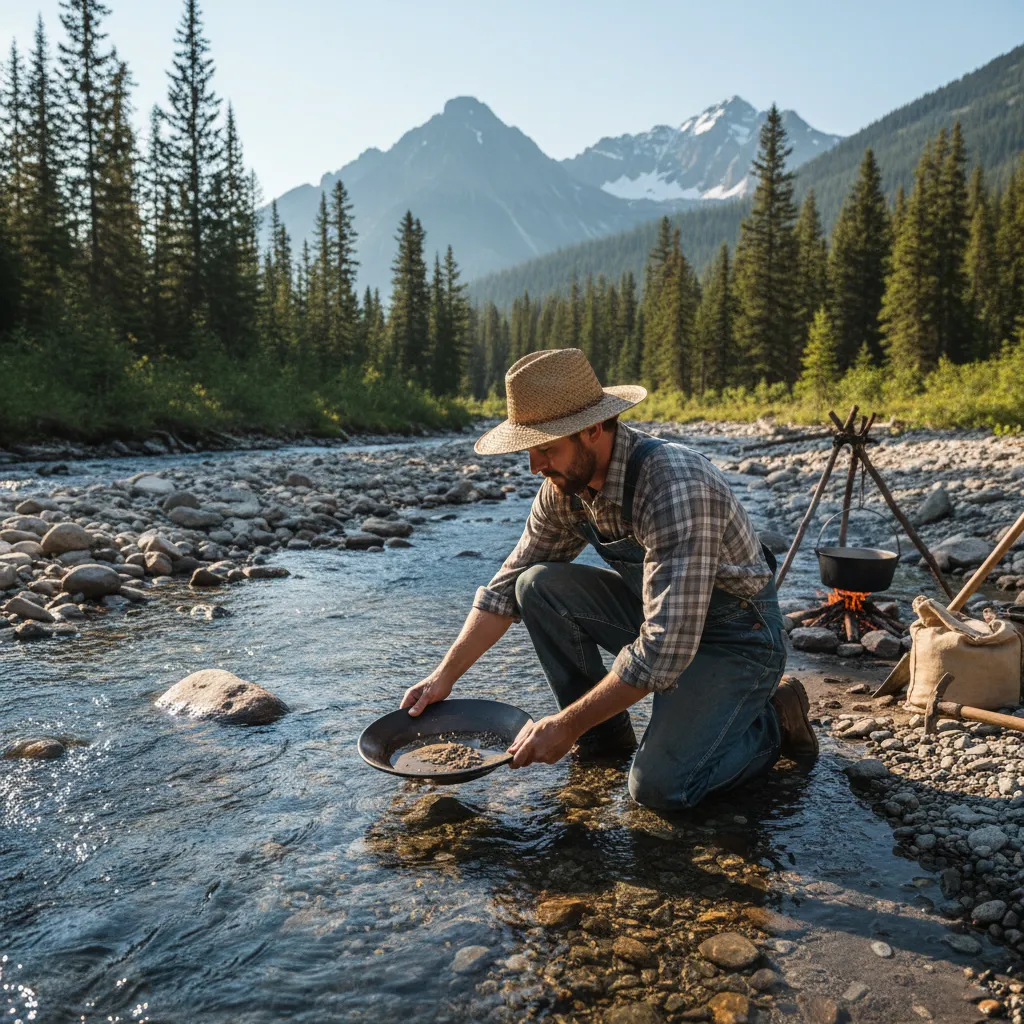
The simplest and cheapest method. You scoop gravel into a pan, submerge it in water, and use a swirling motion to wash lighter material over the edge while gold sinks to the bottom. A skilled panner processes about one pan every 5-10 minutes. It’s slow but effective for sampling — this is how you figure out where to set up heavier equipment. Every prospector should know how to pan, even if they primarily use other methods. My beginner’s guide to gold panning walks through the technique step by step.
Sluice Boxes
A sluice is basically a long trough with riffles (raised bars) along the bottom. You set it in the stream current, shovel gravel into the top, and water does the sorting. Gold drops behind the riffles while lighter material washes through. A sluice processes 10-50 times more material per hour than panning. It’s the best bang-for-your-buck upgrade after a pan.
Dredging and Dry Washing
Suction dredges vacuum gravel from the streambed and run it through a sluice. They’re the most efficient recreational method but are heavily regulated or banned in many states — California banned suction dredging entirely.
Dry washers use air instead of water to separate gold from dry desert gravels. Essential for Arizona and other arid prospecting areas where water isn’t available.
Highbankers and Power Sluices
A highbanker is a portable sluice with its own water pump, so you can process gravel away from the stream. It combines the volume of a sluice with the flexibility of working material from locations water can’t reach — like bench placer deposits above the creek.
How Much Is Placer Gold Worth?
Placer gold is typically worth 90-95% of the spot gold price when sold as raw gold to a refiner. As of 2026, with gold prices above $3,000 per troy ounce, that means raw placer gold runs roughly $2,700-$2,850 per ounce depending on purity.
However, most recreational prospectors don’t find gold by the ounce. A realistic good day might yield 1-3 grams of fine gold (worth $90-$270 at current prices). Nuggets and interesting specimens can sell for significantly more than melt value to collectors — a well-shaped nugget might fetch 2-5x the gold price from a collector or jeweler.
Is placer mining still profitable? As a business, rarely — labor costs and equipment make commercial placer mining marginal at small scale. As a hobby that occasionally pays for your gas and gear? Absolutely. Most recreational prospectors measure success in enjoyment, not dollars.
Is Placer Gold Prospecting Legal?
Yes, recreational gold panning is legal in most US states, but regulations vary wildly by location. The key factors:
- Public land (BLM/Forest Service): Generally open to recreational panning with hand tools. Motorized equipment like dredges usually requires permits.
- Active mining claims: Off-limits without the claim holder’s permission. Check BLM’s LR2000 database for claim status.
- State parks and national parks: Almost always prohibited.
- Private land: Requires landowner permission.
Some states like California have banned suction dredging entirely. Others like Colorado and Georgia are very friendly to recreational prospectors. Before you head out, read the complete guide to gold panning laws by state — the fines for prospecting in the wrong spot aren’t worth the risk.
Modern Tools for Finding Placer Gold
Today’s prospectors have advantages the forty-niners couldn’t have imagined. Beyond the traditional pan and sluice, modern technology can dramatically improve your odds of finding productive ground.
USGS databases and mine maps. The Mineral Resources Data System (MRDS) and state geological survey records document thousands of known placer gold occurrences. I built GoldFever.app specifically to put 75,000+ mine sites and mineral occurrences on an interactive map you can search from your phone — so you can scout locations before driving out and check for nearby documented deposits while you’re in the field.
Metal detectors designed for gold nugget hunting can find pieces as small as a grain of rice in favorable ground conditions. They’re most effective in areas with coarse placer gold rather than fine flour gold. If you’re interested in this approach, check out the metal detecting for gold guide.
GPS and satellite imagery. Google Earth lets you scout stream bends, gravel bars, and bench deposits from your couch. Mark promising spots and navigate to them in the field. Look for the same features you’d look for on foot — inside bends, exposed bedrock, old channel benches — but at a scale that would take days to walk.
Topographic apps. USGS topo maps on your phone show elevation contours that reveal bench deposits, old channel terraces, and terrain features invisible at ground level. Combined with geological maps, you can identify promising placer ground without leaving your truck.
Tips for Finding Placer Gold
Sample before you commit. Take quick pans from five different spots before spending three hours in one location. Work crosswise — perpendicular to the stream — to locate the pay streak. Mark which pans had color, go back to the best one. I learned this after spending an entire Saturday working a dead stretch while a better spot was fifty feet upstream.
The surface lies. Gold works its way down through gravel. The good stuff is at bedrock level, or sitting on the first impenetrable layer (clay or cemented gravel). If you’re only panning surface material, you’re leaving gold behind.
Timing matters. Late summer and early fall mean lower water levels. More exposed gravel bars, easier access to bedrock, less current fighting your pan. I go in September when the crowds thin out and the water drops.
After a flood, check the high-water line. High water moves gold around and deposits it along the waterline as levels recede. Some of my best finds have been right after spring runoff.
Read the shape of your gold. Flat, smooth, polished flakes mean the source is far away — you’re finding well-traveled gold. Rough, jagged pieces with angular edges and rust staining mean you’re close to where the gold originated. If you start finding coarse, chunky gold, work upstream. The lode source could be nearby.
Bring the right gear. You don’t need much to get started — a pan, a classifier, a snuffer bottle, and some vials. Check the complete equipment guide to make sure you’re not overspending or under-prepared.
Frequently Asked Questions
What is the difference between placer gold and lode gold? Placer gold is loose gold that’s been weathered free from its original rock and transported by water into stream deposits. Lode gold (hard rock gold) is still embedded in its host rock — typically quartz veins — and must be mined by drilling, blasting, or crushing the rock. Placer gold is what recreational prospectors target because it can be recovered with simple tools like pans and sluice boxes.
Where is placer gold found? Placer gold is found in streams, rivers, and ancient waterways that drain gold-bearing geological formations. In the United States, the richest placer deposits are in California, Alaska, Colorado, Arizona, Oregon, Idaho, and the Appalachian gold belt from Georgia to Virginia. Gold concentrates at inside stream bends, behind boulders, in bedrock cracks, and in ancient river channels above the current waterline.
How much is placer gold worth? Raw placer gold typically sells for 90-95% of the spot gold price. With gold above $3,000/oz in 2026, that’s roughly $2,700-$2,850 per ounce from a refiner. Attractive nuggets and specimens can command 2-5x melt value from collectors. Most recreational prospectors find 1-3 grams on a productive day, worth roughly $90-$270.
Is placer mining still profitable? As a commercial business at small scale, placer mining is marginally profitable at best due to labor and equipment costs. As a recreational hobby, many prospectors recover enough gold to cover their gas and gear expenses. The real value for most people is the outdoor experience and the thrill of finding gold. Large-scale commercial placer operations in Alaska and parts of the western US remain profitable with the right ground and equipment.
How do you mine placer gold? The most common methods are gold panning (simplest, best for sampling), sluice boxes (10-50x faster than panning), highbankers (portable sluice with water pump), suction dredges (most efficient but heavily regulated), and dry washers (for arid environments). Most recreational prospectors start with a pan and upgrade to a sluice box once they find productive ground.
The Bottom Line on Placer Gold
Placer gold is nature’s way of doing the hard work for you — weathering gold free from rock, transporting it by water, and concentrating it in predictable locations. Understanding how it forms, how water moves it, and what different deposit types look like gives you a massive advantage over the prospector who just shows up at a creek and starts digging randomly.
I’m not going to pretend you’ll get rich prospecting. That ship sailed in 1852. But I fish, I hike, I camp — and nothing gives me the same stupid grin as seeing gold flash in the bottom of a pan. My wife thinks I’m ridiculous. She’s probably right. But she also wore the gold flake earrings I had made from a season’s worth of flour gold, so I think she gets it more than she lets on.
If you’re just starting out, check out my beginner’s guide to gold panning for the step-by-step technique. Or see where gold is found across the US if you want the bigger picture before you decide where to start.